

When someone dies leaving a will in Queensland, the executor named in that will usually cannot begin administering the estate straight away. Banks, the land titles office, and share registries all need proof that the will is valid and that the executor has legal authority to act. That proof is probate.
Probate is Queensland’s official recognition that a deceased person’s will is legally valid and that the executor named in it has the court’s approval to administer the deceased’s estate according to the terms of the will. It is a grant issued by the Supreme Court of Queensland under the Succession Act 1981 (Qld), and it gives the executor the authority to collect assets, pay debts, and distribute the estate to beneficiaries.
This guide explains everything you need to know about probate in QLD — what it is, when it is required, how the application process works, how long it takes, and what it costs.
On This Page
- What Does Probate Actually Mean?
- Probate vs Letters of Administration in Queensland
- When Is Probate Required in QLD?
- What Are Probate Assets?
- The Probate Process in Queensland — Step by Step
- How Long Does Probate Take in Queensland?
- What You Need for a Probate Application
- How Much Does Probate Cost in QLD?
- What Happens If Someone Disputes the Will?
- Frequently Asked Questions About Probate in QLD
What Does Probate Actually Mean?
The word “probate” comes from the Latin probatum, meaning “a thing proved.” In practical terms, probate confirms that the deceased person’s will has been examined by the Supreme Court of Queensland and found to be their last valid will.
When the court grants probate, it is doing two things simultaneously. First, it verifies that the document presented to the court is genuine — that it was properly signed, witnessed, and represents the true intentions of the person who died. Second, it confirms the executor’s legal authority to act on behalf of the estate.
Without probate, the executor has no formal standing to deal with the deceased’s property, close bank accounts, transfer shares, or sell real estate. Financial institutions and government bodies will simply not release assets to someone who cannot produce a grant of probate.
Key point: Probate is not about deciding who gets what. The will determines that. Probate is the court’s approval granted to the executor confirming the will is valid and giving them the authority to carry out its instructions.
Probate vs Letters of Administration in Queensland
People often confuse probate with letters of administration, but they apply in different circumstances.
Probate is granted when there is a valid will and the executor named in that will is willing and able to act. The executor applies for probate and, once granted, administers the estate according to the will’s terms.
Letters of administration are required when there is no will (the person died “intestate”), when the will does not name an executor, or when the named executor cannot or will not act. In these situations, an eligible person — usually the next of kin — applies to the Supreme Court for authority to administer the estate.
Both grants serve the same practical purpose: giving someone the legal authority to deal with the estate’s assets. The key difference is that probate involves a will while letters of administration apply where no executor is available. If you need guidance on the letters of administration process in Queensland, we have a separate guide covering that topic in detail.
When Is Probate Required in QLD?
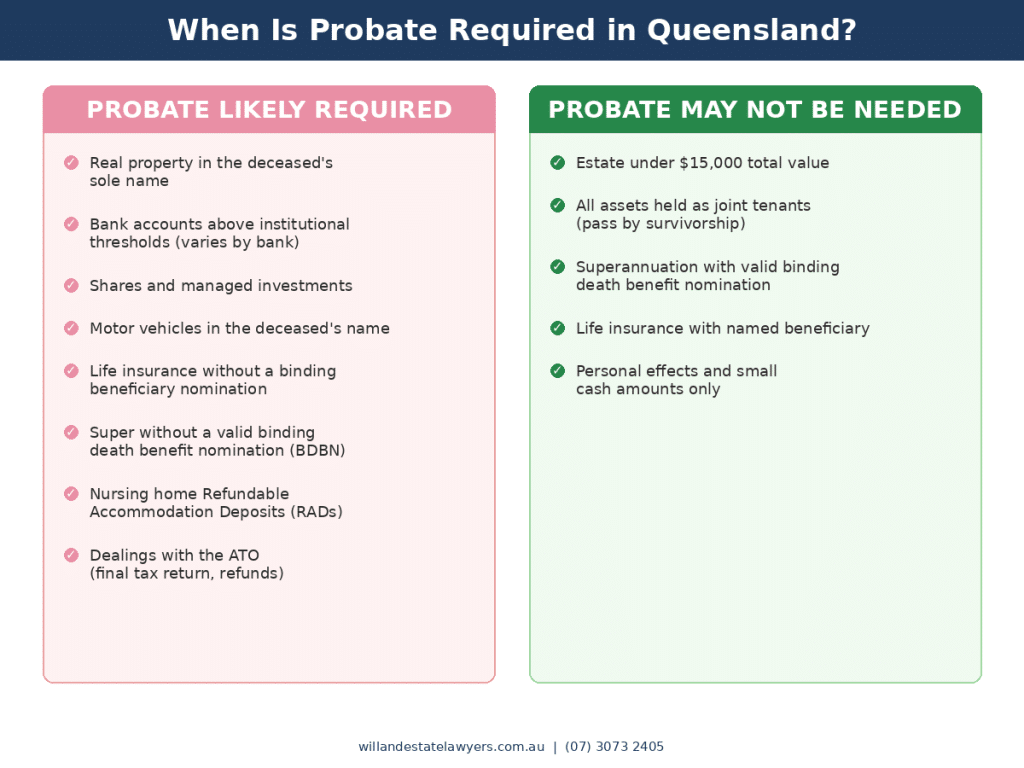
Not every estate requires probate. Whether you need to obtain probate in Queensland depends on the type and value of the deceased’s assets.
Probate is generally required when the deceased estate includes:
- Real property — any land or house held in the deceased’s name alone (not as joint tenants)
- Bank accounts exceeding institutional thresholds — most banks require probate for accounts holding more than $15,000 to $50,000, depending on their internal policies
- Shares and managed investments — share registries require a grant before transferring or selling holdings
- Motor vehicles registered in the deceased’s name — the Department of Transport and Main Roads typically requires a grant for transfer
- Life insurance policies where there is no nominated beneficiary or the nomination is non-binding
- Superannuation where there is no valid binding death benefit nomination (BDBN) — the super fund trustee will typically require a grant before releasing the death benefit
- Nursing home Refundable Accommodation Deposits (RADs) — aged care providers require a grant of probate before refunding the deposit
- Dealings with the Australian Taxation Office (ATO) — lodging the deceased’s final tax return and managing any tax liabilities or refunds generally requires the executor to have a grant of probate
Probate may not be required when:
- The estate is very small (often under $15,000 in total)
- All assets were held as joint tenants (they pass automatically to the surviving joint tenant by right of survivorship)
- Superannuation and life insurance have valid binding nominations directing payment to a specific beneficiary
- The only assets are personal effects and small cash amounts
If you are unsure whether probate is required for your situation, it is worth getting professional advice early. Applying for probate when it is not needed wastes time and money, but failing to apply when it is required means you cannot access the estate’s assets. Our team can assess your circumstances and advise whether obtaining probate in Queensland is necessary.
What Are Probate Assets?
Understanding which assets form part of the probate estate is one of the most confusing aspects of estate administration for executors.
Probate assets are those held solely in the deceased’s name that require a grant of probate before they can be dealt with. These typically include real property held as tenants in common, bank accounts held solely, shares, vehicles, business interests, and personal property of significant value.
Non-probate assets pass outside the will entirely. Jointly held property passes by survivorship. Superannuation with a valid binding death benefit nomination is paid directly to the nominated beneficiary. Life insurance with a named beneficiary operates the same way.
An executor’s first task is usually to compile a full list of the estate assets and determine which ones require probate. This asset identification process forms the foundation of the entire administration.
The Probate Process in Queensland — Step by Step
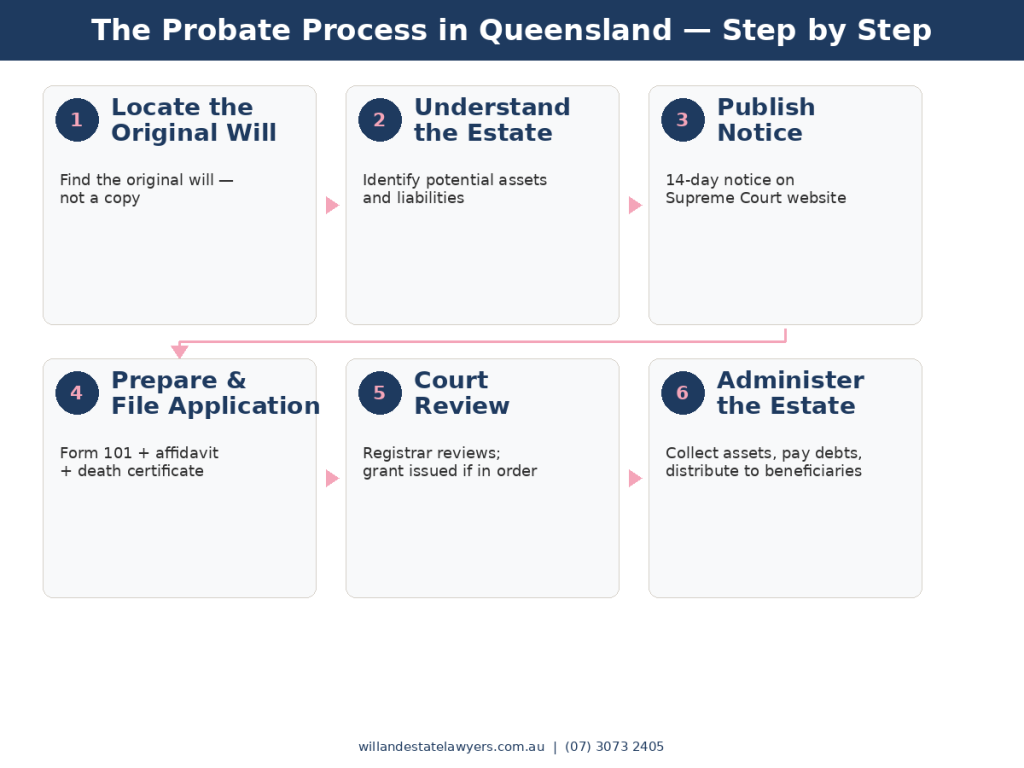
The process of obtaining probate in Queensland follows a structured sequence set out in the Uniform Civil Procedure Rules 1999 (Qld) and the Succession Act 1981 (Qld). Here is how it works in practice.
Step 1: Locate the Original Will
The Supreme Court requires the original will — not a copy. If the original cannot be found, the application becomes significantly more complex and may require a separate court order. Check the deceased’s home, their solicitor’s office, and any other place the deceased may have stored important documents.
Step 2: Understand What the Estate May Include
The executor needs to develop an understanding of what assets may comprise the estate and what liabilities may form part of it. This means contacting banks, superannuation funds, share registries, the land titles office, and any other institutions where the deceased may have held assets. You should also identify potential outstanding debts, including mortgages, personal loans, credit cards, and any tax liabilities.
It is worth noting that in Queensland, many institutions will not release full details about the deceased’s accounts or holdings until a grant of probate has been made. At this stage, the goal is to gather enough information to determine whether probate will be required to administer the estate — not necessarily to compile a complete and final asset list.
Step 3: Publish a Notice of Intention to Apply for Probate
Before filing the application, the executor must publish a notice of intention to apply for a grant on the Supreme Court of Queensland website. This notice must remain published for at least 14 days. The notice gives any interested parties — such as potential beneficiaries or creditors — the opportunity to lodge a caveat or raise concerns before the grant is issued.
Step 4: Prepare and File the Probate Application
The application is filed in the Supreme Court of Queensland using Form 101 — Application for Probate (or Form 102 for letters of administration). The application must be accompanied by:
- The original will (and any codicils)
- The death certificate
- An affidavit sworn by the executor (the Executor’s Affidavit) confirming identity, the relationship to the deceased, and details of the estate
- An affidavit of publication confirming the notice was published
- The applicable court filing fee
If the will contains any irregularities — such as informal amendments, missing witness signatures, or interlineations — additional affidavit evidence may be required to satisfy the court that the document is nonetheless valid.
Step 5: The Court Reviews and Grants Probate
The Supreme Court Registrar reviews the application. If everything is in order and no caveats have been filed, the court issues the grant of probate. This grant is the formal document the executor uses to prove their authority to banks, the titles office, and other institutions.
Step 6: Administer the Estate
Once probate is granted, the executor can begin collecting the estate assets, paying debts and liabilities, and ultimately distributing the remaining property to the beneficiaries named in the will. The executor must administer the estate in accordance with both the will and the requirements of the Succession Act 1981.
How Long Does Probate Take in Queensland?
The timeline for probate in Queensland depends on the complexity of the estate and whether any issues arise during the application process.
For a straightforward application where the will is clearly valid, there are no disputes, and all documents are properly prepared, the process typically takes 4 to 8 weeks from the date the application is filed with the Supreme Court. This does not include the 14-day notice period, which must run before the application can be filed.
However, the total time from the date of death to the completion of estate administration is usually longer. Gathering asset information and preparing the application often takes 2 to 4 weeks before the application is even filed. After probate is granted, distributing the estate to beneficiaries takes additional time — particularly if property needs to be sold.
For a more detailed breakdown of probate timeframes, including what causes delays and how to speed things up, see our guide on how long probate takes in QLD.
Factors that can delay the probate process include:
- Difficulties locating the original will
- Irregularities in the will that require additional affidavit evidence
- A caveat being lodged against the grant
- Family provision applications or other disputes
- Complex estate assets requiring valuation (businesses, trusts, overseas property)
- Incomplete or incorrect application forms
For most estates, the entire process from death to final distribution takes between 3 and 12 months. Disputed estates can take significantly longer.
What You Need for a Probate Application
Getting the application right the first time avoids costly delays. Here is a checklist of what is required for a probate application in the Supreme Court of Queensland:
- Original will (and any codicils) — photocopies are not accepted unless the original is lost, in which case a separate application is required
- Death certificate — the official certificate issued by the Registry of Births, Deaths and Marriages
- Form 101 — the standard Application for Probate form prescribed by the UCPR
- Executor’s affidavit — a sworn statement covering the executor’s identity, relationship to the deceased, details of the estate, and confirmation that the notice of intention was published
- Affidavit of publication — confirming the notice of intention was published for at least 14 days
- Court filing fee — the current fee varies depending on the value of the estate
- Identification documents — proving the executor’s identity
If the will was not properly witnessed, contains informal amendments, or if there is any doubt about the deceased’s testamentary capacity, additional supporting affidavits will be required. These situations are more complex and benefit from experienced probate assistance.
How Much Does Probate Cost in QLD?
The cost of obtaining probate in Queensland has two components: the Supreme Court filing fee and professional fees if you engage a solicitor to handle the application.
Court filing fees in Queensland are a flat fee of $819.90 regardless of the size of the estate. If the person applying for probate holds a valid concession card, they may be eligible for a reduced filing fee. There is also an additional cost of $161.70 for advertising the notice of intention to apply.
Legal fees vary significantly across the market. Many firms charge between $1,500 and $3,000 or more for a standard probate application. At Will & Estate Lawyers Australia, we offer a fixed fee of $825 (inclusive of GST) for straightforward probate applications, which includes preparing all forms, the executor’s affidavit, publishing the notice, filing the application, and corresponding with the court through to the grant being issued.
A fixed fee means you know exactly what the legal costs will be before you start — no hourly billing surprises. For a full breakdown of all costs involved, including court fees, advertising, and legal fees across different providers, see our detailed guide on probate costs in QLD.
Need Help With Probate in Queensland?
Our team handles probate applications across Queensland every week. We offer a fixed fee of $825 (inclusive of GST) for standard probate applications, and we manage the entire process from start to finish.
Get a free quote online or call us on (07) 3073 2405 to discuss your situation.
What Happens If Someone Disputes the Will?
Disputes can arise during or after the probate process. The most common types of estate disputes in Queensland include:
Family provision applications — an eligible person (such as a spouse, child, or dependant) who believes they have not been adequately provided for can apply to the court under Part 4 of the Succession Act 1981 for further provision from the estate. Notice of the application must be given within 6 months of the date of death, and the application itself must be filed within 9 months of the date of death.
Will validity challenges — someone may argue that the will is invalid due to lack of testamentary capacity, undue influence, fraud, or failure to comply with formal execution requirements.
Caveats — any interested person can lodge a caveat with the Supreme Court to prevent a grant of probate from being issued. The caveat effectively pauses the probate process until the dispute is resolved, either by agreement or by further court order.
If you are an executor dealing with a contested estate, or if you believe you have been unfairly left out of a will, it is critical to get legal advice promptly. Strict time limits apply, and missing a deadline can extinguish your rights entirely. Our will dispute lawyers can advise on your options.
Frequently Asked Questions About Probate in QLD
How do I know if probate is required in QLD?
Probate is usually required when the deceased held assets solely in their name — such as real property, bank accounts above institutional thresholds, or share portfolios. If all assets were jointly held or have valid beneficiary nominations, probate may not be necessary. The simplest way to find out is to contact the institutions holding the deceased’s assets and ask whether they require a grant of probate before releasing funds.
Do all wills have to go through probate in Australia?
No. Whether probate is required depends on the nature and value of the estate’s assets, not the existence of a will itself. A will may exist but if the estate consists only of jointly held assets and superannuation with binding nominations, there may be no assets that require a grant of probate to deal with. Each state and territory in Australia has its own probate rules, and this guide covers Queensland specifically.
How long does probate take in Queensland?
A straightforward probate application typically takes 4 to 8 weeks from filing to the grant being issued. The overall estate administration process — from death to final distribution — usually takes 3 to 12 months depending on the complexity of the estate, whether property needs to be sold, and whether any disputes arise.
Under what circumstances do you need probate?
You generally need probate whenever the deceased held assets solely in their name that need to be transferred or sold. The most common triggers are real estate in the deceased’s sole name, bank accounts exceeding the bank’s threshold for release without a grant, and shareholdings. If you are named as executor and are unsure, contact the relevant financial institutions — they will tell you whether they require a grant.
Can I apply for probate myself without a lawyer?
Yes, it is possible to apply for probate without a lawyer. The Supreme Court of Queensland provides the required forms, and the process is administrative rather than adversarial. However, mistakes in the application can cause significant delays, and if the will has any irregularities, additional legal knowledge is often required. Many executors find that engaging a lawyer — particularly at a fixed fee — saves time and stress.
How long after probate can funds be distributed in QLD?
Executors should generally wait at least 9 months from the date of death before making final distributions. This is because eligible persons have up to 6 months from the date of death to give notice of a family provision application, and up to 9 months from the date of death to file the application itself. Distributing the estate before this period expires means the executor may be personally liable if a successful claim is later made. Interim distributions are possible in some circumstances with appropriate legal advice.
