

Receiving the grant of probate from the Supreme Court of Queensland is a significant milestone, but it’s just the beginning of estate administration. As executor, you now have legal authority to collect assets, pay debts, and distribute the estate to beneficiaries. Our $1490 fixed-fee probate service helps executors through this process, and most estates are fully administered within 6-9 months of death.
This guide explains exactly what happens after probate is granted in Queensland, including the step-by-step process for administering a deceased estate, important waiting periods, and your responsibilities under Queensland law.
In This Article
- What Legal Authority Does the Grant Give You?
- Step-by-Step Estate Administration Process
- Collecting the Deceased’s Assets
- Paying Debts and Liabilities
- The Six-Month Waiting Period
- How Long After Probate Can Funds Be Distributed?
- Final Distribution to Beneficiaries
- Executor Duties and Personal Liability Risks
- What If Someone Contests the Will?
- Getting Help With Estate Administration
- Frequently Asked Questions
What Legal Authority Does the Grant Give You?
The grant of probate is a court order issued by the Supreme Court of Queensland that formally recognises your authority as the executor named in the will. Before this grant is issued, financial institutions, the land registry, and share registries have no way to verify that you’re entitled to deal with the deceased person’s assets.
With the sealed grant in hand, you can now:
- Access bank accounts: Present the grant to banks to close accounts and transfer funds into an estate account
- Sell or transfer real estate: Lodge the grant with Titles Queensland to deal with land and property
- Collect shares and investments: Notify share registries to transfer or sell shareholdings
- Recover debts: Collect any money owed to the deceased person
- Deal with superannuation: Work with super funds where the estate is the nominated beneficiary
The grant effectively tells the world: “This person has the legal right to administer this estate according to the terms of this will.”
Step-by-Step Estate Administration Process
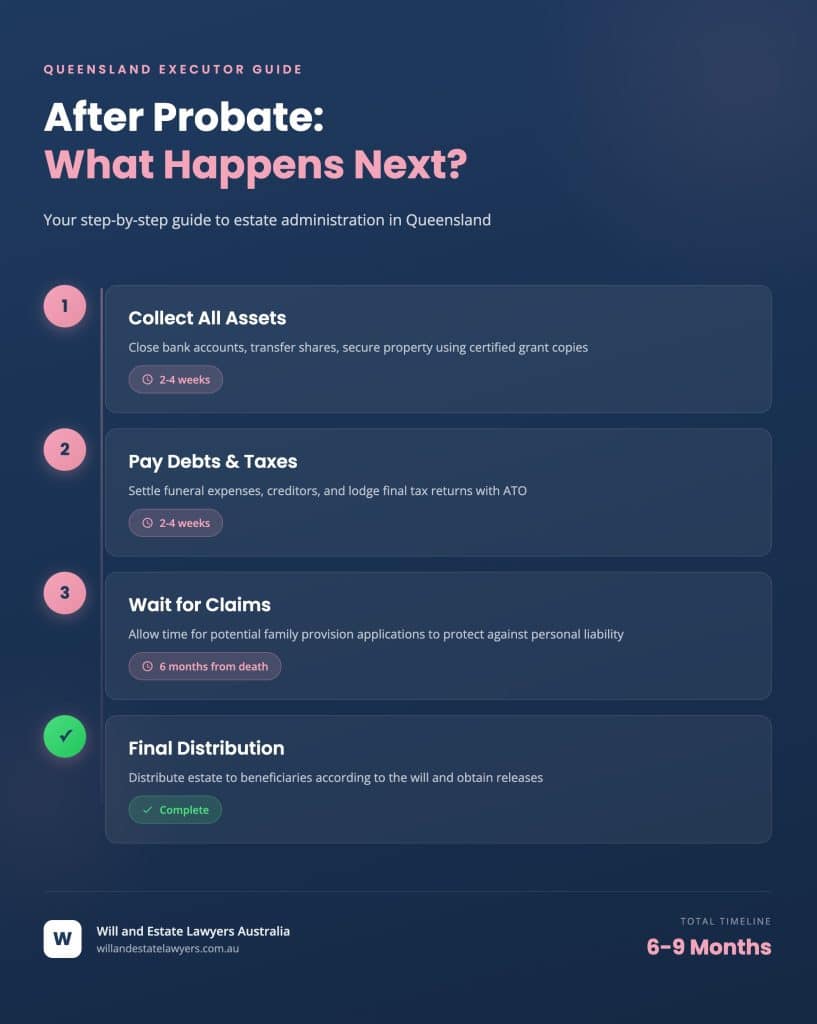
Estate administration in Queensland follows a logical sequence. While every estate is different, most executors work through these stages after receiving their grant of probate.
Stage 1: Collect All Assets
Your first task is gathering everything the deceased owned. This includes closing bank accounts, transferring shares into the estate, collecting rent or other income owed, and securing physical property. Most executors open a dedicated estate bank account to manage incoming funds.
Stage 2: Identify and Pay Debts
Before you can distribute anything to beneficiaries, you must settle the deceased’s legitimate debts. This includes funeral expenses, outstanding bills, mortgages, credit cards, and any tax obligations. Paying creditors from estate funds is one of the executor’s core responsibilities under Queensland law.
Stage 3: Prepare Final Tax Returns
The deceased may have outstanding tax returns that need lodging. You’ll also need to prepare a final tax return covering income from the start of the financial year to the date of death, plus a separate estate tax return for any income earned by the estate during administration.
Stage 4: Wait for Potential Claims
Queensland law gives eligible family members six months from the date of death to notify an intention to make a family provision claim. Prudent executors wait this period before making final distributions to protect themselves from personal liability.
Stage 5: Distribute the Estate
Once debts are paid and the waiting period has passed, you can distribute the estate to beneficiaries according to the will’s instructions. This is the final step in administering an estate in Queensland.
Collecting the Deceased’s Assets
With your grant of probate, you can now approach asset holders to collect what belongs to the estate. Different institutions have different processes, but all will require certified copies of the grant.
Bank Accounts and Term Deposits
Contact each bank where the deceased held accounts. You’ll typically need to provide a certified copy of the grant, the death certificate, completed closure forms, and identification. Most banks release funds within 1-3 weeks of receiving complete documentation. Consider transferring everything into a single estate bank account for easier administration.
Real Estate and Land
Titles Queensland requires the grant of probate to record a change of ownership for property held in the deceased’s sole name. If you’re selling the property, your conveyancer will need the grant to complete the transfer. The process is different for property held as joint tenants, which passes automatically to the surviving owner.
Shares and Managed Funds
Each share registry has its own procedures. You’ll need to provide the grant, a transmission form, and sometimes a small estate declaration. The registry will either transfer shares into your name as executor or sell them and remit the proceeds to the estate.
Superannuation
Superannuation doesn’t automatically form part of the estate. If the deceased had a binding death benefit nomination to the estate (rather than to named individuals), you’ll need to claim those funds using the grant. This can take 4-8 weeks depending on the fund.
Paying Debts and Liabilities
Before distributing anything to beneficiaries, executors must pay all valid debts and liabilities. This protects both creditors and the executor from future claims.
Order of Payment
Queensland law establishes a priority for paying estate debts:
- Funeral and testamentary expenses – Reasonable funeral costs and the costs of obtaining probate come first
- Secured creditors – Mortgages and loans secured against specific assets
- Priority debts – Employee wages, some tax debts
- Unsecured creditors – Credit cards, personal loans, utility bills
- Beneficiaries – Only after all debts are paid
What About Unknown Creditors?
Some executors advertise in the newspaper and Government Gazette, giving creditors notice to come forward and claim against the estate. While not mandatory in Queensland, this provides additional protection if undiscovered debts emerge later.
Personal Liability Warning
If you distribute estate assets without paying legitimate debts, you may become personally liable to unpaid creditors. This is why proper estate administration matters, and why many executors engage probate lawyers Queensland to guide them through the process.
The Six-Month Waiting Period
One of the most important things executors need to understand is the six-month waiting period under Queensland’s Succession Act 1981.
Why Six Months Matters
Eligible persons (spouses, children, dependants under 18) have up to six months from the date of death to give notice of their intention to make a family provision application. This is a claim that the will doesn’t make adequate provision for the claimant’s maintenance and support.
If the executor distributes estate assets before six months has passed, and someone later makes a successful family provision claim, the executor may be held personally liable for the distributed assets. The beneficiaries might not return what they’ve received, leaving the executor to pay from their own pocket.
Statutory Protection After Six Months
Once six months passes from the date of death (not the date of probate), executors gain statutory protection. If no notice of claim has been received, you can distribute with confidence that you won’t be personally liable for any future family provision applications.
Early Distributions
In genuine cases of financial hardship, executors may make interim distributions before six months. However, this carries risk and should only be done after obtaining legal advice. The Public Trustee of Queensland can also apply to court for early distribution in appropriate circumstances.
How Long After Probate Can Funds Be Distributed?
The timeline for distributing funds depends on several factors, but most straightforward estates follow this pattern:
| Stage | Typical Duration | Running Total |
|---|---|---|
| Collecting assets after grant | 2-4 weeks | 2-4 weeks |
| Paying debts and taxes | 2-4 weeks | 4-8 weeks |
| Waiting for claims (from death) | 6 months from death | 6 months |
| Final distribution | 1-2 weeks | 6-7 months from death |
Important: The six-month clock starts from the date of death, not from when probate is granted. So if probate took 8 weeks to obtain, you’ve already used up 2 months of the waiting period.
Realistic Total Timeline
Most Queensland estates are fully administered within 6-9 months of death. Complex estates involving property sales, business interests, or disputes can take 12-18 months or longer.
Final Distribution to Beneficiaries
The final step is distributing the estate according to the will’s instructions. Before making distributions, ensure you’ve:
- Collected all assets and income
- Paid all debts, liabilities, and taxes
- Obtained final tax clearances
- Waited the six-month claim period
- Set aside funds for any ongoing administration costs
Getting Releases
It’s good practice to have beneficiaries sign a release acknowledging they’ve received their inheritance and releasing you from further liability as executor. This provides protection if disputes arise later.
Executor’s Entitlement to Commission
Most executors don’t realise they’re entitled to claim commission for administering the estate. Under Queensland law, executors may claim up to 5% of the estate’s value as commission. Courts generally approve reasonable claims, particularly for estates requiring significant work.
Executor Duties and Personal Liability Risks
Being an executor carries significant responsibilities. Understanding the risks helps you avoid common pitfalls that lead to personal liability.
Key Executor Duties
- Act honestly and in the best interests of all beneficiaries
- Keep accurate records and accounts
- Invest estate funds prudently
- Distribute according to the will (not your personal preferences)
- Complete administration within a reasonable timeframe
- Avoid conflicts of interest
Case Study: Early Distribution Risk
Consider this scenario: Matt was executor of his late friend Simon’s estate. He completed probate, administered the estate efficiently, and distributed everything to Maddie (Simon’s sister and sole beneficiary) just five months after death. The next day, Liz contacted Matt claiming to be Simon’s de facto partner and indicated she was making a family provision claim.
Because Matt distributed before the six-month protection period, he may be personally liable if Liz’s claim succeeds. Maddie has gone overseas and isn’t returning calls, and certainly isn’t returning any money. Matt is now potentially on the hook personally.
How to Protect Yourself
- Wait the full six months before distributing
- Keep detailed records of all transactions
- Seek legal advice when uncertain
- Consider executor’s insurance for large estates
What If Someone Contests the Will After Probate?
A common misconception is that obtaining probate prevents the will from being contested. This is incorrect. The grant of probate only confirms the will is valid; it doesn’t prevent family provision claims.
Family Provision Claims
Eligible persons can still make a claim for further provision from the estate even after probate has been granted. These claims allege that the will doesn’t make adequate provision for the claimant’s proper maintenance and support. The Supreme Court of Queensland can order additional provision be made from the estate.
Your Role If a Claim Is Made
If someone notifies you of an intention to contest, do not make any distributions. You’ll need to:
- Preserve estate assets
- Notify beneficiaries of the claim
- Engage lawyers to defend the estate
- Potentially attend mediation or court proceedings
The good news is that legal costs for defending the estate are paid by the estate, not personally by the executor. Courts expect executors to retain lawyers to help lawfully administer estates when disputes arise.
For more information, see our guide on contesting a will in Queensland.
Getting Help With Estate Administration
Estate administration can feel overwhelming, particularly when you’re also grieving. Many executors choose to engage professional help to ensure they fulfil their duties correctly.
What Professional Help Includes
Our estate administration services guide executors through each stage of the process, from obtaining probate to final distribution. We help with:
- Preparing and lodging probate applications ($1490 fixed fee)
- Advising on asset collection and debt payment
- Preparing estate accounts
- Navigating family provision claims
- Ensuring compliance with Queensland law
When to Seek Legal Advice
Consider professional assistance if:
- The estate includes real property
- There are potential family provision claims
- You’re uncertain about any executor duties
- Beneficiaries are disputing the will
- The estate has significant debts
For estates without a valid will, you’ll need letters of administration instead of probate. The administration process is similar, but the intestacy rules determine who inherits.
Frequently Asked Questions
What happens after a grant of probate in Queensland?
After receiving the grant of probate from the Supreme Court of Queensland, the executor collects all estate assets, pays debts and taxes, waits six months from death for potential claims, and then distributes the remaining estate to beneficiaries according to the will. Most Queensland estates are fully administered within 6-9 months of death.
How long after probate can funds be distributed in QLD?
While you can begin collecting assets immediately after receiving probate, you should wait at least six months from the date of death before making final distributions. This waiting period protects executors from personal liability if someone makes a family provision claim. Premature distribution can leave the executor personally liable for successful claims.
How long after probate is granted does it take to receive inheritance in QLD?
Beneficiaries typically receive their inheritance within 6-9 months of death for straightforward estates. This accounts for the time to obtain probate (6-10 weeks), collect assets (2-4 weeks), pay debts, and observe the six-month claim waiting period. Complex estates with property sales or disputes take longer.
Can a will be contested after probate in Queensland?
Yes. Obtaining probate confirms the will is valid but doesn’t prevent family provision claims. Eligible persons (spouses, children, dependants under 18) can still claim the will doesn’t make adequate provision for them. They must give notice within 6 months of death and file within 9 months.
Need Help With Estate Administration?
If you’re an executor navigating the post-probate process, our team can help. We offer fixed-fee probate services from $1490 and can guide you through the entire estate administration process.
Call (07) 3103 9846 or request a free quote today for same-day assistance.
