

When a family member passes away and you’re left to deal with their estate, you’ll quickly encounter two confusing terms: probate and letters of administration. Many executors and family members assume these are just different names for the same thing. They’re not. While both are Supreme Court grants that give you legal authority to administer a deceased estate, which one you need depends entirely on whether there’s a valid will.
Understanding the difference matters because applying for the wrong one wastes weeks of time and can cost you hundreds in additional court fees. If you’ve been named executor in a will, you’ll need probate. If someone died without a will or their will doesn’t name an executor, you’ll need letters of administration. The application process is similar, but the legal requirements differ in important ways.
At Will and Estate Lawyers Australia, we help Queenslanders obtain both probate and letters of administration for a fixed $825 legal fee – around 55% cheaper than typical market rates of $1,500 to $3,000. In this guide, you’ll learn exactly what each grant is, when you need one, and how to get started.
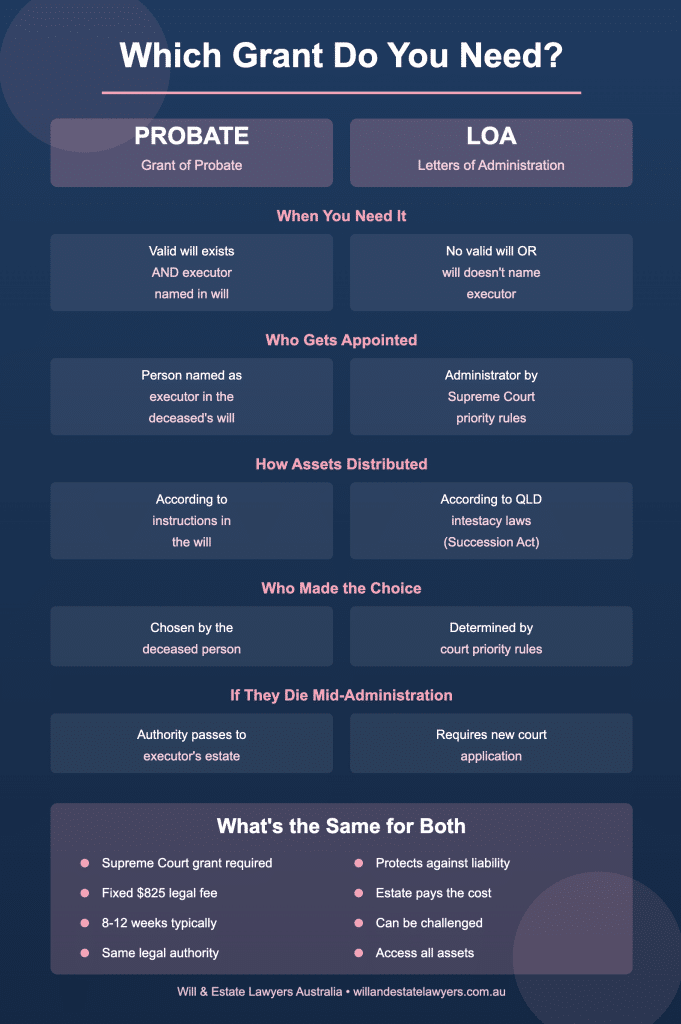
What is Probate?
Probate is a legal document issued by the Supreme Court that proves a will is valid and gives the executor legal authority to administer the deceased person’s estate. The grant of probate allows executors to access bank accounts, sell property, transfer shares, and distribute assets to beneficiaries according to the deceased’s will.
The probate process exists to protect everyone involved in the estate. It ensures the deceased person’s wishes are carried out correctly, protects executors from personal liability, gives financial institutions confidence they’re releasing assets to the right person, and creates a public record that allows creditors and potential claimants to come forward.
You can only obtain probate if the deceased left a valid will that names you as executor. The court reviews the will to confirm it meets Queensland’s legal requirements – proper witnesses, the deceased had testamentary capacity, no signs of fraud or undue influence. Once satisfied, the court issues the grant with a sealed copy of the will attached.
The person granted probate is called the executor. This term comes from the will itself, where the deceased specifically nominated that person to “execute” (carry out) the instructions in their will. Executors have a fiduciary duty to follow the will’s terms and act in beneficiaries’ best interests throughout the administration.
What are Letters of Administration?
Letters of administration is a grant issued by the Supreme Court that appoints an administrator to control and administer the estate when there is no valid will. Like probate, it gives legal authority to collect assets, pay debts, and distribute the estate – but instead of following a will, administrators must distribute according to Queensland’s intestacy laws.
Letters of administration are required in three main scenarios. First, when someone dies intestate (without a will). Second, when a will exists but doesn’t name an executor. Third, when the named executor cannot or will not act – perhaps they’ve passed away, lack capacity, or simply don’t want the responsibility.
The administrator is appointed by the court based on priority rules set out in the Uniform Civil Procedure Rules 1999. The person with the greatest entitlement to inherit under intestacy laws has first priority to be appointed. This usually means a spouse has priority over children, children over grandchildren, and so on down the family line.
One key difference from probate: if an executor passes away before completing the administration, their estate’s personal representative can continue the work without reapplying to court. If an administrator dies mid-administration, someone must apply to the court again for letters of administration de bonis non (to complete the remaining work).
The Key Differences Between Probate and Letters of Administration
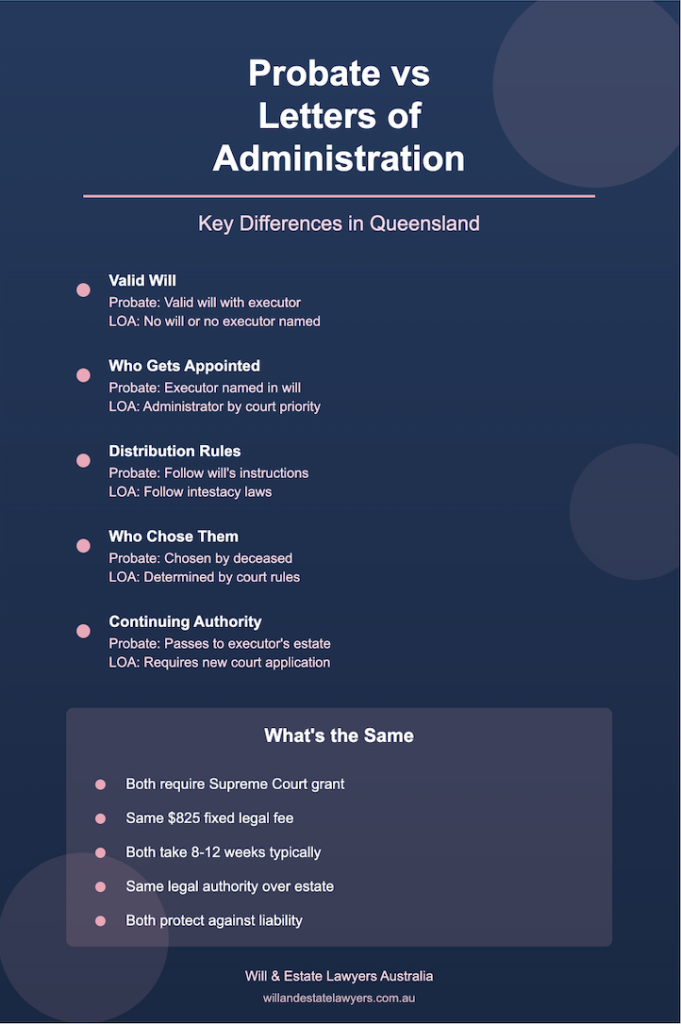
Both grants authorise the recipient to control and administer deceased estates. Both require Supreme Court applications with similar documentation, advertising, and filing requirements. Our fixed $825 legal fee covers either type of application. But several important differences exist:
What determines which you need: Probate requires a valid will naming an executor. Letters of administration are for estates without a will, or where the will doesn’t name an executor or the named executor can’t act.
Who receives the grant: The executor is named in the deceased’s will. The administrator is appointed by the court based on priority rules favouring those with the greatest entitlement to inherit.
Distribution rules: Executors must follow the will’s specific instructions for distributing assets. Administrators must follow Queensland’s intestacy laws regardless of what they think the deceased would have wanted.
Continuing authority: If an executor dies mid-administration, their personal representative can usually complete the work. If an administrator dies, a fresh court application is required.
Court scrutiny: Both applications receive court review, but letters of administration applications may face more scrutiny about the administrator’s entitlement to be appointed, especially if multiple family members could claim priority.
Put another way, probate recognises the executor the deceased chose and confirms the will they left. Letters of administration fills the gap when no executor was chosen or no will exists, with the court appointing someone based on legal priority rather than the deceased’s wishes.
When You Need Probate
Most estates with real estate, bank accounts over $25,000, or share portfolios require probate before institutions will release the assets. Financial institutions refuse to release funds without a grant because they need protection from liability if they pay the wrong person.
You’ll typically need to apply for probate when the deceased left a valid will and:
- Real estate: Property in the deceased’s name must be transferred or sold, and the land registry requires probate
- Bank accounts: Balances exceed the bank’s threshold (usually $20,000-$50,000 depending on institution)
- Shares: Publicly listed securities need to be transferred from the deceased’s name to beneficiaries or sold
- Superannuation: Some super funds require probate depending on binding death benefit nominations
- Disputed estates: Family members threaten to contest the will or bring family provision claims
Not every estate needs probate. Small estates with minimal assets, jointly owned property that passes to the surviving owner, or assets with nominated beneficiaries may not require a court grant. Banks and institutions make this determination based on their own policies and risk tolerance.
The probate process in Queensland typically takes 8 to 12 weeks from initial consultation to receiving the sealed grant. This includes preparing court documents, publishing mandatory advertisements, filing with the Supreme Court, court processing time, and responding to any requisitions.
When You Need Letters of Administration
If someone died without a will, or their will doesn’t name an executor, you’ll need letters of administration before you can access most estate assets. The same asset thresholds apply – banks, land registry, and share registries usually require a grant for the same types and values of assets that would need probate.
Common situations requiring letters of administration include:
Intestacy: The deceased never made a will, or destroyed their will, or the will they left is invalid due to improper execution, lack of capacity, or undue influence.
Will kit problems: Many DIY wills overlook the executor appointment section entirely, necessitating letters of administration even though a will exists. This is called “letters of administration with the will annexed.”
Executor unable to act: The named executor has passed away, lacks mental capacity, lives overseas and can’t travel, is facing bankruptcy, or simply doesn’t want the responsibility.
Executor disputes: Multiple executors are named but can’t agree to act jointly, or family members contest the executor’s appointment due to concerns about their suitability.
The application process mirrors probate applications. You prepare an originating application and affidavit, advertise in approved publications, notify the Public Trustee, file with court filing fees, and wait for the grant. Our legal fee of $825 covers letters of administration applications just as it does probate.
One additional complexity: if you’re applying for letters of administration, you’ll need to demonstrate your entitlement to be appointed over other potential applicants. The court may require statutory declarations from higher-priority family members renouncing their right to apply, or evidence that no higher-priority person exists.
How to Get Started
If you’re dealing with a deceased estate and unsure whether you need probate or letters of administration, start by locating the original will. If you find a valid will naming an executor, you’ll likely need to apply for probate. If there’s no will, or the will doesn’t name an executor, you’ll need to apply for letters of administration.
We begin every matter with a free initial consultation to assess whether a grant is actually required for your specific estate. Not every estate needs Supreme Court involvement, and we’ll tell you honestly if you can manage without professional assistance.
For estates that do require a grant, our $825 fixed legal fee includes:
- Initial consultation to determine probate or letters of administration
- Preparation of all Supreme Court documents in approved form
- Arrangement and payment of mandatory advertising (you pay $161.70 outlay)
- Notification to the Public Trustee as required
- Filing of the application with court filing fees (you pay $819.90 outlay)
- Responding to any court requisitions
- Collection and provision of certified grant copies
The total investment for obtaining probate or letters of administration in Queensland is $1,806.60 including our legal fee, court costs, and advertising – compared to typical market rates of $2,540 to $2,880 charged by other firms.
The estate pays these costs, not you personally. Queensland courts expect executors and administrators to retain legal advisors to help lawfully administer estates, and the legal fees are properly deducted from estate assets before calculating any executor’s commission.
Frequently Asked Questions
Do you need both probate and letters of administration?
No. You need either probate (if there’s a valid will with named executor) or letters of administration (if no will, or will without executor). You cannot obtain both for the same estate. The type of grant depends entirely on whether a valid will exists.
Can letters of administration be challenged?
Yes. Family members can contest the appointment of an administrator if they believe they have better entitlement to be appointed, or if they consider the proposed administrator unsuitable due to capacity concerns, conflict of interest, or inability to properly fulfill their duties. These contests are resolved by the Supreme Court before the grant issues.
How long does it take to get letters of administration compared to probate?
The timeframe is similar for both – typically 8 to 12 weeks in Queensland for straightforward applications. Letters of administration may take slightly longer if multiple family members could claim priority and the court needs to verify the applicant’s entitlement, but properly prepared applications with supporting documentation move through the court at similar speeds.
What happens if you distribute an estate without probate or letters of administration?
Executors and administrators who distribute estate assets without proper court authority face personal liability if problems arise later. This could include creditor claims, family provision applications, or beneficiary disputes. Banks and institutions also typically refuse to release assets without a grant, making unauthorised distribution practically difficult even if you wanted to attempt it.
Can you get letters of administration if the will is being contested?
Yes. If there’s a dispute about the will’s validity, the court may appoint an administrator pendente lite (pending litigation) to collect assets, pay bills, and preserve the estate while the will contest proceeds. This prevents the estate deteriorating or assets being wasted during the dispute.
Whether you need probate or letters of administration, the process doesn’t have to be overwhelming. We’ve helped Queensland families obtain over 500 grants, and we know exactly how to prepare applications that the Supreme Court approves on first submission.
Contact us for a free consultation to discuss your specific situation. Call us now, or get a quote and we’ll get back to you within 24 hours. We’re here to make estate administration as simple as possible during what we know is already a difficult time.
