

In this guide:
- What Are Letters of Administration?
- When Are Letters of Administration Needed in Queensland?
- Probate vs Letters of Administration
- How Queensland Intestacy Rules Decide Who Inherits
- Who Can Apply for Letters of Administration in QLD?
- The Application Process
- Common Scenarios That Require Letters of Administration
- Letters of Administration QLD Cost
- How Long Does It Take?
- Frequently Asked Questions
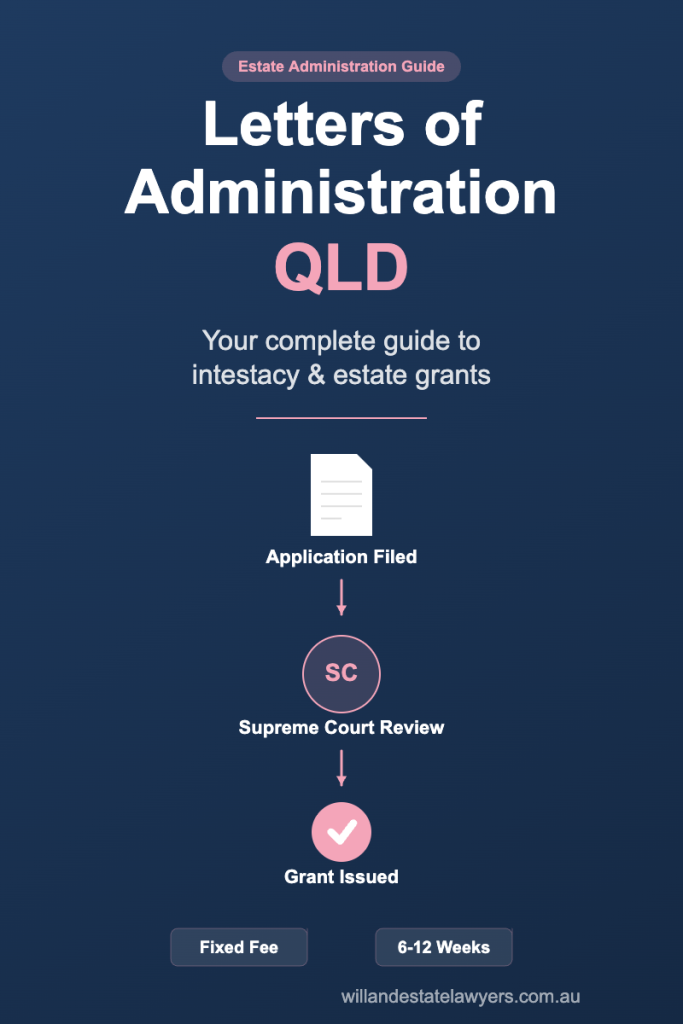
When someone has passed away without a valid will — or their will doesn’t name an executor who can act — the deceased estate can’t simply be administered by a family member. Queensland law requires a formal grant from the Supreme Court before anyone has the legal authority to collect assets, pay debts, and distribute the estate. That grant is called Letters of Administration, and for families dealing with an intestate estate, it’s the essential first step. Our Letters of Administration QLD service handles the entire application for a fixed fee of $1490, but this guide explains exactly what’s involved so you understand the process before engaging anyone.
What Are Letters of Administration?
Letters of Administration is a document issued by the Supreme Court of Queensland that formally appoints an administrator to manage a deceased person’s estate. Think of it as the court’s way of saying: “You are now legally authorised to deal with this person’s assets and debts.”
Without this grant, banks, the land registry, share registries, and superannuation funds will not release assets to you — no matter how close your relationship to the deceased. The grant of administration shows that the court has examined the application, verified the applicant’s entitlement, and confirmed there is no valid will appointing an executor.
In practical terms, Letters of Administration gives you the same legal authority as probate gives an executor named in a will. The difference is simply the starting point: probate applies when there is a valid will with an appointed executor, while Letters of Administration applies when there isn’t.
When Are Letters of Administration Needed in Queensland?
You’ll need to apply for Letters of Administration in Queensland whenever the deceased estate includes assets that institutions won’t release without a court grant. The most common situations are:
- No will exists at all — the person died intestate, meaning Queensland’s statutory intestacy rules govern who inherits and who can administer the estate
- The will doesn’t name an executor — sometimes will kits or informal documents leave this critical appointment blank
- The named executor has died — if the sole executor predeceased the will-maker and no substitute was named, there’s no one with authority to act
- The executor renounces — an executor can decline the appointment, and if there’s no alternate, Letters of Administration with the will annexed becomes necessary
- The will is invalid — if the will fails to meet the execution requirements under the Succession Act 1981 (Qld), the estate may be treated as intestate
Not every deceased estate requires a court grant. Smaller estates where assets are held jointly (and pass by survivorship) or where the total value falls below institutional thresholds may not need Letters of Administration at all. But where property is held in the deceased’s sole name, or bank accounts exceed certain limits, the grant is required before anything can be transferred or released.
Probate vs Letters of Administration: What’s the Difference?
This is one of the most common questions families have, and the distinction matters because it determines which application you file with the Supreme Court.
Probate is the grant you receive when there is a valid will and it names an executor who is willing and able to act. The court confirms the will is genuine and authorises the executor to carry out the deceased’s wishes. If you need probate, our probate QLD service covers the full process.
Letters of Administration is the grant you receive when there is no valid will, or there is a will but no executor able to act. The court appoints an administrator — typically the person with the greatest entitlement under intestacy law — and authorises them to administer the estate according to either the will (if one exists) or Queensland’s intestacy rules.
Both grants serve the same fundamental purpose: giving one person the legal authority to deal with the deceased estate. Both are filed with the Probate Registry of the Supreme Court. Both require similar documentation. The key practical difference is that with Letters of Administration, the administrator must follow statutory distribution rules rather than the deceased’s written wishes — unless a will exists but simply lacks an executor, in which case it’s called “Letters of Administration with the will annexed” and the will’s directions still apply.
How Queensland Intestacy Rules Decide Who Inherits
When there’s no will, Part 3 of the Succession Act 1981 (Qld) sets out exactly how the estate must be distributed. This isn’t discretionary — the administrator must follow these rules. Understanding them is important because they also determine who has priority to apply for the grant.
The distribution hierarchy works like this:
Spouse but no children: The surviving spouse (including a de facto partner of at least two years) receives the entire residuary estate — everything left after debts and administration expenses are paid.
Spouse and children: The spouse receives $150,000, all household chattels (furniture, personal items, household pets), plus one-third of whatever remains. The children share the remaining two-thirds equally. If there’s only one child, the split is 50/50 on the residue instead.
Children but no spouse: The children inherit the entire estate in equal shares. If any child predeceased the intestate, that child’s share passes to their own children (the deceased’s grandchildren) under section 36A of the Succession Act.
No spouse or children: The estate passes down a strict priority order — parents first, then siblings, then nieces and nephews, then grandparents, then aunts and uncles, then first cousins. Only if no relatives at all can be identified does the estate pass to the Crown.
One common misconception is that dying without a will in Queensland means the government automatically takes everything. That’s not how it works. The intestacy rules cast a wide net through the family tree. But they can produce outcomes the deceased would never have chosen — stepchildren, for example, receive nothing under intestacy law despite potentially having lived in the family home for years.
Who Can Apply for Letters of Administration in QLD?
Chapter 15 of the Uniform Civil Procedure Rules 1999 (Qld) establishes a priority order for who can apply. The Supreme Court generally appoints the person who stands to receive the largest benefit from the estate, following this hierarchy:
- Surviving spouse or de facto partner
- Children of the deceased
- Grandchildren
- Parents
- Siblings
- Nieces and nephews
- Grandparents
- Aunts and uncles
- First cousins
- Any person the court considers appropriate (including the Public Trustee of Queensland)
If you’re not the highest-priority applicant, you’ll generally need written consent from those above you in the order, or a satisfactory explanation for why they’re not applying. For example, if a child wants to apply but the surviving spouse doesn’t want the role, the spouse provides a consent or renunciation.
The Letters of Administration Application Process
The application to the Probate Registry of the Supreme Court follows a structured legal process. While the specifics vary depending on the estate’s complexity, the general steps are:
Gather the required documents. You’ll need the original death certificate, evidence of the deceased’s assets and liabilities, proof of your relationship and entitlement, and declarations from relevant parties. If a will exists but lacks an executor, the original will must be filed too.
Prepare the court forms. The application includes affidavits and supporting material that must comply with the court’s requirements. Errors or omissions lead to requisitions — formal requests from the registry for corrections — which delay the process.
Advertise the application. Queensland law requires that you publish a notice in the Queensland Law Reporter, giving potential creditors and other interested parties the opportunity to come forward. The mandatory advertising fee is $161.70.
File with the Supreme Court. The application is lodged with the Probate Registry along with the court filing fee of $819.90. The registry reviews the application and may raise requisitions if anything needs clarification.
Receive the grant. Once the court is satisfied that everything is in order, it issues the Letters of Administration. You can then take this document to banks, the land registry, and other institutions to deal with the deceased’s assets.
Having a lawyer handle the application is particularly valuable for intestate estates because the documentation requirements are more complex than a straightforward probate application. Our Letters of Administration service prepares the entire application, handles any requisitions, and guides you through to the grant for a fixed fee of $1490.
Common Scenarios That Require Letters of Administration
In our experience administering hundreds of Queensland estates, these are the situations families encounter most often:
The “we never got around to it” scenario. A couple owns a home together as tenants in common. One partner dies without a will. The surviving partner assumes the property automatically transfers, but because it’s held as tenants in common (not joint tenants), the deceased’s share forms part of their estate. Letters of Administration is needed to transfer that share.
The will kit that missed the executor. Someone purchased a will kit from a newsagent or online, filled in their beneficiaries, but either forgot to name an executor or named someone who has since died. The will itself may be valid — the wishes are clear — but without an executor, the court needs to appoint an administrator. This results in Letters of Administration with the will annexed.
The sole executor who predeceased the will-maker. Dad named Mum as sole executor in his will. Mum passed away first, and Dad never updated his documents. When Dad dies, there’s a valid will but no executor. Again, Letters of Administration with the will annexed is needed.
The blended family intestacy. A parent dies without a will, leaving a spouse and children from a previous relationship. Under Queensland intestacy rules, the spouse receives $150,000 plus household chattels plus one-third of the residue, while the children from the earlier relationship share two-thirds. Neither side may be happy with this statutory division, but the administrator is legally bound to follow it — unless a family provision application changes the outcome.
Letters of Administration QLD Cost
The total cost to obtain Letters of Administration in Queensland has three components:
Legal fees: Our fixed fee is $1490 for the complete application. This covers preparation of all court documents, lodging the application, handling any requisitions from the Probate Registry, and advising you through to the grant. Many firms charge $1,500 to $3,000 for the same legal work, so our fixed-fee approach offers significant savings.
Supreme Court filing fee: $819.90 (this is a flat fee set by the court regardless of estate value).
Queensland Law Reporter advertising: $161.70 for the mandatory public notice.
Your total out-of-pocket cost is therefore $1490 + $819.90 + $161.70. We provide this full breakdown upfront so there are no surprises — unlike firms that quote legal fees alone and then add disbursements later.
How Long Does It Take to Get Letters of Administration in QLD?
Most straightforward applications take between 6 and 12 weeks from the date we lodge with the Supreme Court to receiving the grant. The main variables that affect timing are:
- Whether all required documents are available at the outset
- The Probate Registry’s current processing times (these fluctuate)
- Whether the registry raises any requisitions on the application
- Whether there are any competing claims or disputes among potential administrators
Complex estates — those involving multiple potential administrators, interstate assets, or disputes about the validity of a will — can take longer. But for the typical Queensland estate where the family is in agreement about who should administer, 6 to 12 weeks is a realistic expectation.
Frequently Asked Questions
How long does it take to get Letters of Administration in QLD?
Most applications are processed within 6 to 12 weeks from lodgement with the Supreme Court. Straightforward estates where all documents are in order and there are no competing claims tend to be at the shorter end. More complex matters involving disputes, interstate assets, or missing documentation can extend beyond 12 weeks.
Who gets Letters of Administration?
The Supreme Court grants Letters of Administration to the person with the highest priority under Queensland law. For intestate estates, this is typically the surviving spouse, followed by children, parents, and other relatives in order. If you’re not the highest-priority applicant, you need consent from those ranked above you.
Are Letters of Administration needed for every estate?
No. Small estates where assets are held jointly and pass by right of survivorship, or where total assets fall below institutional thresholds (usually around $50,000 depending on the institution), may not require a grant. However, any estate with real property in the deceased’s sole name or significant bank balances will almost certainly need Letters of Administration if there’s no valid will with an executor.
Can I apply for Letters of Administration myself?
You can apply as a self-represented litigant, but the process involves preparing legal documents that must meet the Supreme Court’s strict requirements. Errors lead to requisitions and delays. Given that professional assistance from a firm like ours costs $1490 as a fixed fee — and handles the entire process including any requisitions — most families find professional help saves both time and stress.
What’s the difference between Letters of Administration and Letters of Administration with the will annexed?
Standard Letters of Administration applies when there is no will at all (full intestacy). Letters of Administration with the will annexed applies when a will exists but there’s no executor able to act — perhaps because the executor died, renounced, or was never named. With the will annexed, the administrator follows the will’s directions for distribution rather than intestacy rules.
This article provides general information about Letters of Administration in Queensland and does not constitute legal advice. For advice specific to your circumstances, please contact us for a consultation. The fees stated are for our legal services only. Additional costs such as court filing fees and advertising costs apply as outlined above.
Need Help With Letters of Administration?
Our fixed-fee Letters of Administration service handles the entire Supreme Court application from $1490. We prepare all documents, manage the Probate Registry process, and guide you through to the grant. Call (07) 3103 9846 for a free initial assessment, or request a quote online.
