

Can a De Facto Partner Contest a Will?
Yes, de facto partners can contest a will in Queensland. Under the Succession Act 1981 (Qld), a de facto partner is included in the definition of “spouse” and has the same legal standing to make a family provision application as a married husband or wife.
This means if your de facto partner has died and left you nothing, left you less than you need, or distributed the estate in a way that doesn’t adequately provide for your maintenance and support, you have the legal right to contest the will through the Queensland Supreme Court.
The formal process is called a family provision application (sometimes referred to as a family provision claim or FPA). These claims allow eligible persons to ask the court to adjust an estate distribution when the deceased’s will failed to make adequate provision for their proper maintenance and support.
If you’re considering contesting a will as a de facto partner, the most important thing to understand is the strict time limits that apply. You must notify the executor of your intention to claim within 6 months of the death, and you must file your application with the Supreme Court within 9 months of the death.
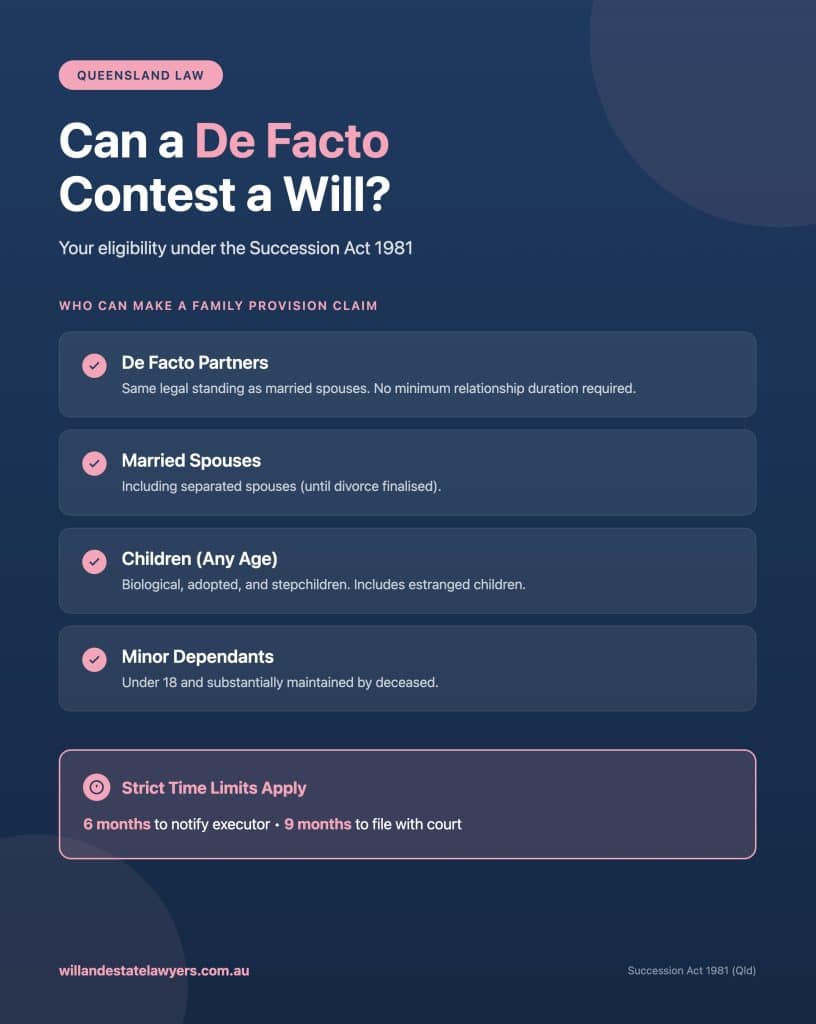
Table of Contents
- What Qualifies as a De Facto Relationship in Queensland?
- How De Facto Partners Can Contest a Will
- Time Limits for Contesting a Will in QLD
- What the Court Considers in De Facto Claims
- De Facto Partners vs Former Spouses
- What Happens If You’re Left Out of a Will Entirely
- Can You Exclude Your De Facto Partner from Your Will?
- The Family Provision Application Process
- Evidence Needed for a De Facto Will Contest
- How Much Could a De Facto Partner Receive?
- No-Win-No-Fee Claims for De Facto Partners
- Frequently Asked Questions
What Qualifies as a De Facto Relationship in Queensland?
Under Section 5AA of the Succession Act 1981 (Qld), a de facto relationship exists when two people (regardless of gender) live together as a couple on a genuine domestic basis, without being legally married.
Important: Unlike some other Australian states, Queensland does not require a minimum relationship duration for de facto partners to be eligible to contest a will. Whether your relationship lasted 6 months or 20 years, you have standing to make a family provision claim.
The Queensland law considers several factors when determining whether a de facto relationship existed:
The duration of the relationship is considered, though no minimum period is required. Courts also look at the nature and extent of your common residence—did you share a home together as a genuine couple? Financial dependence or interdependence matters, as does whether there was a sexual relationship. Property ownership and acquisition patterns are examined, along with mutual commitment to a shared life.
Courts also consider the care and support of children, and the public reputation of the relationship. Were you known to family, friends, and the community as a couple?
Same-sex relationships are treated identically to opposite-sex relationships under Queensland succession law. The law has recognised same-sex de facto partners since 2002.
If you’re unsure whether your relationship qualifies, an experienced estate lawyer can assess your situation during a free consultation.
How De Facto Partners Can Contest a Will
De facto partners contest wills in Queensland through a family provision application. This is a formal court application asking the Supreme Court to vary the distribution of the deceased estate because the will failed to make adequate provision for your proper maintenance and support.
The two-stage test the court applies:
First, the court asks whether the will failed to make adequate provision for your proper maintenance and support. This isn’t about whether the distribution was “fair” or what you expected—it’s whether you’ve been left without adequate means to support yourself.
Second, if the answer to the first question is yes, the court determines what provision ought to be made. The court has wide discretion here and considers your needs, the size of the estate, and competing claims from other beneficiaries.
A family provision application is different from challenging a will’s validity. If you believe the will was made under undue influence, the testator lacked mental capacity, or the will was improperly executed, that’s a separate type of proceeding. As a de facto partner, you may have grounds for either type of claim depending on your circumstances.
Time Limits for Contesting a Will in QLD
The time limits for contesting a will in Queensland are strict and missing them can destroy your claim.
Within 6 months of death: You must give written notice to the executor that you intend to make a family provision claim. This notice protects your position because once an executor receives your notice, they cannot lawfully distribute the estate without either providing for your claim or getting court approval.
Within 9 months of death: Your family provision application must be filed with the Supreme Court of Queensland. This is a hard deadline. While extensions are possible, they require court approval and become increasingly difficult to obtain as time passes.
Why timing matters: If the executor distributes the estate after the 9-month period without notice of your claim, there may be nothing left to claim against. Even if the court grants you an extension, recovering assets that have already been distributed to beneficiaries can be extremely difficult or impossible.
If you’ve recently lost your de facto partner and are concerned about a will, don’t wait to seek legal advice. Many people hesitate because they’re grieving, but the time limits run regardless of your emotional state.
What the Court Considers in De Facto Claims
When assessing a de facto partner’s family provision claim, Queensland courts apply principles established by the High Court in landmark cases including Singer v Berghouse (1994) and Vigolo v Bostin (2005).
Key factors the court considers:
Your financial position: What are your current assets, income, expenses, and liabilities? Do you have earning capacity? What are your housing needs?
Your contributions to the deceased and their estate: Did you contribute financially? Did you provide care or domestic services? Did you support the deceased through illness? These contributions strengthen your moral claim to provision from the estate.
The length and nature of your relationship: While there’s no minimum duration, a longer relationship with a strong domestic partnership typically supports a stronger claim.
The size of the estate: Courts balance your needs against what’s available. A larger estate generally allows for more generous provision, while smaller estates may limit what’s possible.
Competing claims: The deceased may have had obligations to other people—adult children, a former spouse receiving maintenance, or minor dependants. In QLD, a stepchild is automatically eligible to contest too. The court weighs everyone’s needs.
Any provision already made: If the will left you something, the court considers whether that provision is adequate, not whether you’re completely excluded.
The testator’s reasons: If the deceased provided written reasons for their distribution, the court considers these—though they don’t bind the court’s decision.
De Facto Partners vs Former Spouses
Both de facto partners and former spouses can make family provision claims in Queensland, but their circumstances are typically quite different.
Current de facto partners at the time of death have strong standing to contest. Like married spouses, they were in an ongoing relationship with the deceased and often have significant financial interdependence, shared property, and reasonable expectations of inheritance.
Former spouses (meaning divorced persons) can only contest a will if they were receiving spousal maintenance from the deceased at the time of death. This maintenance can be under a court order or a binding financial agreement. Former spouses who weren’t receiving maintenance cannot make family provision claims, though they may be able to challenge a will’s validity on other grounds.
If you separated from your de facto partner but didn’t formally end the relationship before they died, you may still qualify as a de facto partner depending on the circumstances. The law focuses on the nature of your relationship at the time of death, not on formal documents.
What Happens If You’re Left Out of a Will Entirely
Being completely excluded from your de facto partner’s will can be devastating, but it doesn’t mean you have no rights. Queensland law specifically allows de facto partners to make family provision claims regardless of whether they’re mentioned in the will.
Common reasons de facto partners are excluded:
The will was made before your relationship began and was never updated. The testator had estranged children they wanted to prioritise. There was family conflict about your relationship. The testator incorrectly believed de facto partners didn’t have inheritance rights. The testator was influenced by family members who opposed the relationship.
Your options if you’ve been excluded:
You can make a family provision claim asking the court to provide for you from the estate. The fact that you were excluded entirely doesn’t prevent your claim—it may actually strengthen it, as it suggests the will clearly failed to make adequate provision for your maintenance.
However, the court will still assess your actual needs and weigh them against the size of the estate and competing claims. Being excluded doesn’t guarantee you’ll receive a particular share.
Can You Exclude Your De Facto Partner from Your Will?
You can write a will that excludes your de facto partner, but you cannot prevent them from making a family provision claim.
Many people ask whether they can make their will “contest-proof.” The honest answer is no. Queensland law allows eligible persons—including de facto partners—to apply to the court regardless of the will’s terms. Even if your will includes a clause stating you’ve intentionally excluded your partner, they can still contest.
What you can do to reduce the risk of a successful contest:
Provide reasonable provision for your de facto partner in your will. If the provision is genuinely adequate for their maintenance and support, a contest is unlikely to succeed.
Document your reasons for any reduced provision. While this won’t bind the court, it provides evidence of your intentions and reasoning.
Keep your will updated as circumstances change. Old wills that don’t reflect current relationships are frequently contested.
Consider whether your de facto partner has other resources. If they have substantial independent means, the court is less likely to vary your distribution significantly.
The Family Provision Application Process
Understanding the process helps you know what to expect if you contest a will as a de facto partner.
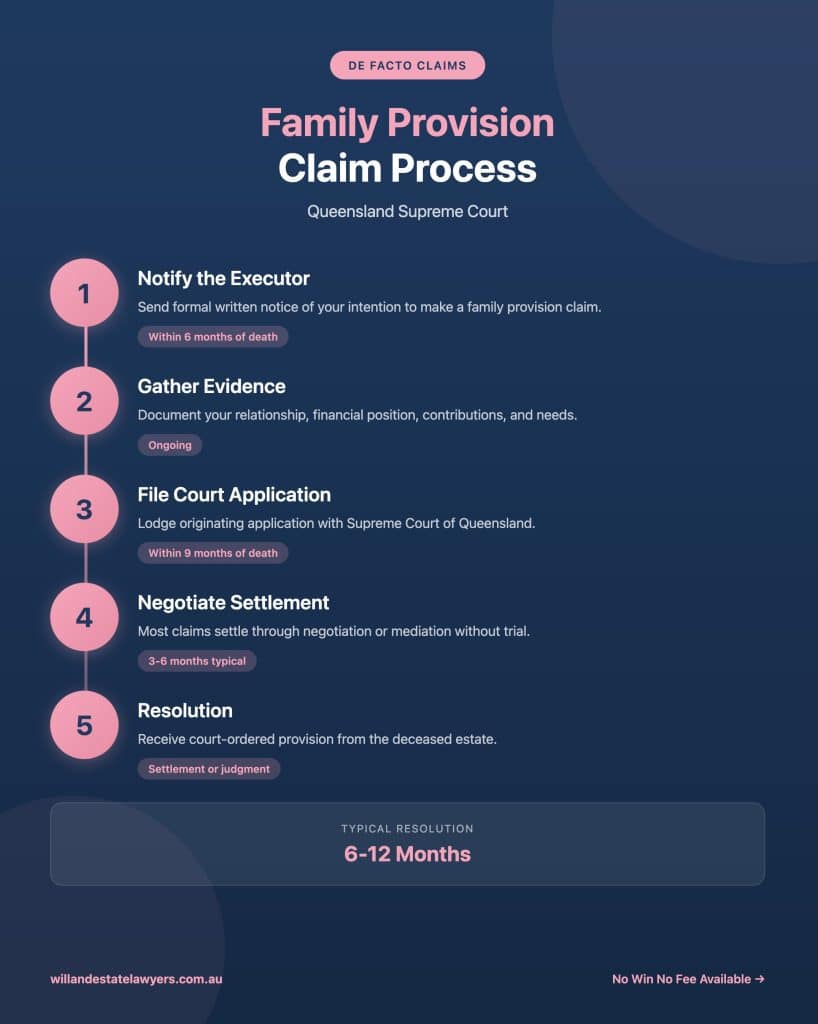
Step 1: Notify the executor (within 6 months)
Your lawyer sends formal written notice to the executor advising that you intend to make a family provision claim. This prevents lawful distribution of the estate without addressing your claim.
Step 2: Gather evidence
You’ll need to document your de facto relationship, your financial position, your contributions to the deceased and their estate, and your needs going forward. This includes financial records, photographs, correspondence, statutory declarations from people who knew your relationship, and valuations of estate assets.
Step 3: File the application (within 9 months)
Your lawyer prepares and files an originating application with the Supreme Court of Queensland, along with supporting affidavits setting out your evidence.
Step 4: Negotiation
Most family provision claims settle through negotiation rather than going to trial. The executor (often represented by a lawyer) will consider your claim and may make a settlement offer. Many claims are resolved at mediation.
Step 5: Court hearing (if necessary)
If negotiation fails, the matter proceeds to a hearing where a judge considers all the evidence and makes a determination. This is relatively rare—the majority of claims settle before reaching this stage.
Evidence Needed for a De Facto Will Contest
Building a strong family provision claim requires evidence in several categories.
Proving your de facto relationship:
Joint financial accounts or shared expenses. Property held in joint names or together. Photographs of you together over the relationship. Correspondence referring to your partnership. Evidence of shared living arrangements (lease agreements, utility bills). Statutory declarations from family and friends who knew you as a couple. Evidence of how you presented your relationship publicly.
Proving your financial needs:
Current income from all sources. Assets including property, superannuation, savings. Liabilities including mortgages, loans, debts. Regular expenses and cost of living. Health issues affecting your earning capacity. Age and future work prospects.
Proving your contributions:
Financial contributions to the household or property. Non-financial contributions like homemaking, caring for the deceased, or supporting their career. Any care provided during illness. Contributions to the deceased’s business or estate.
How Much Could a De Facto Partner Receive?
There’s no fixed formula for how much a de facto partner will receive from a family provision claim. Each case is assessed individually based on the factors described above.
However, de facto partners typically have strong claims because:
They had an ongoing relationship with the deceased implying mutual obligations. They often contributed significantly to the deceased’s welfare and estate. They may have sacrificed career opportunities or financial independence. They frequently have shared living expenses and housing needs.
Typical outcomes for de facto partners:
In estates with a surviving de facto partner and no competing spouse, the de facto partner often receives a significant portion of the estate—sometimes the majority if their needs are substantial and the estate is modest.
Where there are competing claims from adult children, the outcome depends heavily on the children’s circumstances. Adult children who are self-supporting with independent means may receive less than they were left under the will, with provision redirected to the de facto partner.
The “wise and just testator” test guides the court: what would a prudent person have provided, considering all the circumstances and competing moral obligations?
No-Win-No-Fee Claims for De Facto Partners
Family provision claims can be financially daunting. Legal costs for contested estate matters can be substantial, and many people worry about paying lawyer fees from their own pocket while grieving.
How no-win-no-fee works for family provision claims:
You pay no upfront legal fees. We assess your claim and, if we believe it has merit, we take it on a no-win-no-fee basis. If your claim is unsuccessful, you don’t pay our legal fees. If your claim is successful, legal costs are typically paid from the estate as part of the settlement or court order.
This arrangement makes it possible to pursue legitimate claims without financial risk during an already difficult time.
To qualify for no-win-no-fee:
Your claim must have reasonable prospects of success. The estate must have sufficient assets to warrant the claim. You must be an eligible person under the Succession Act 1981 (Qld). You must be within the time limits (or have grounds for an extension).
If you’re a de facto partner considering contesting a will, contact us for a free case assessment to determine whether you have a viable claim.
Frequently Asked Questions
Can a de facto partner contest a will?
Yes. Under Queensland law, de facto partners are included in the definition of “spouse” and have full legal standing to make a family provision application. You can contest a will if it failed to make adequate provision for your proper maintenance and support, whether you were left nothing or received an inadequate share.
On what grounds can you contest a will in Queensland?
De facto partners can contest a will on the ground that it failed to make adequate provision for their proper maintenance and support. This is different from challenging a will’s validity (which is based on testamentary capacity, undue influence, fraud, or improper execution). Most de facto partners pursue family provision claims rather than validity challenges.
Can my de facto partner claim my inheritance?
If you’re asking about property you inherit during a de facto relationship, that’s a family law question about relationship property. If you’re asking whether your de facto partner could contest your will after you die, the answer is yes—eligible persons including de facto partners can make family provision claims regardless of what your will says.
Can I exclude my de facto partner from my will?
You can write a will that leaves nothing to your de facto partner, but you cannot prevent them from making a family provision claim. If the court determines your will failed to make adequate provision for them, it can vary the distribution regardless of your stated intentions. The best protection is to make reasonable provision in the first place.
Need Help Contesting a Will as a De Facto Partner?
If your de facto partner has died and you’re concerned about the will, time is critical. You have 6 months to notify the executor and 9 months to file your application with the court.
We offer free case assessments for de facto partners considering family provision claims. We’ll review your situation, explain your rights under Queensland law, and advise whether you have a viable claim.
For eligible claims, we offer no-win-no-fee representation—you pay nothing unless we’re successful, and costs come from the estate, not your pocket.
Call 07 3073 2405 or request a callback to speak with an experienced estate lawyer about your situation.
This article provides general information about contesting a will as a de facto partner in Queensland. It is not legal advice for your specific situation. Time limits apply to family provision claims—seek legal advice promptly if you’re considering contesting a will.
